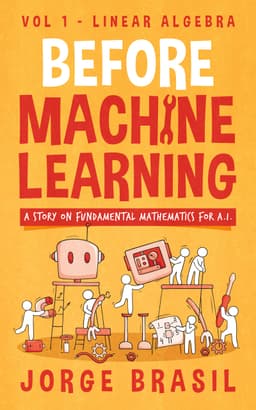
When I tell people I wrote a linear algebra book set in outer space, the first question is always 'why?'. The answer is embarrassingly simple: because that's how I learned it myself.
I spent years struggling with abstract definitions that seemed to float in a vacuum. Then one day, I was watching a documentary about orbital mechanics, and it clicked. Vectors weren't just arrows on a page — they were trajectories. Matrices weren't just grids of numbers — they were transformations that bent the paths of spacecraft.
“Stories give abstract concepts a physical home. Your brain cares. And brains that care, learn.”
Stories give abstract concepts a physical home. When you read that a matrix 'rotates a vector', it's forgettable. When you read that a navigation computer rotates the shuttle's trajectory to avoid an asteroid, the rotation has stakes. Your brain cares. And brains that care, learn.
Each book in the series follows the same principle: find a real story where the maths is the hero, then teach the maths through that story. Bees for calculus. A diamond heist for probability. It takes longer to write, but the retention is night and day.